Why Leaves Arrange Themselves Around a Stem
Why leaves arrange themselves around a stem: learn to identify alternate, opposite and whorled patterns by tracing leaf attachment points node by node.
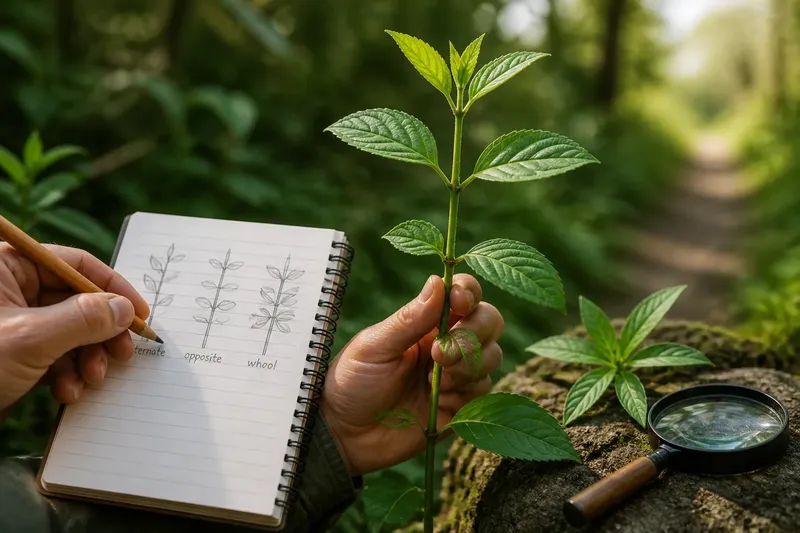
Why leaves arrange themselves around a stem is easiest to answer by tracing each leaf to its attachment point. These points, called nodes, reveal whether leaves grow singly, in pairs or in groups. Their pattern also determines how foliage occupies space around a shoot.
Where should you look first?
Choose a section of stem with several intact leaves. Trace each leaf stalk, or the base of a stalkless leaf, back to the stem. The point where it joins is a node; the stretch between neighbouring nodes is an internode.
Compare the nodes as you move up the stem. One leaf at each node suggests an alternate arrangement. Two leaves attached at the same level, on opposite sides, suggest an opposite arrangement. Three or more leaves attached around one shared node form a whorl.
Turn the plant slowly as you inspect it. A leaf hidden behind the stem can make a pair look like a single leaf, while a crowded shoot can make separate nodes appear level. Following the stem is more reliable than judging the outline of the foliage.
What does alternate arrangement look like?
In an alternate arrangement, each node bears one leaf, and successive leaves often emerge on different sides of the stem. The sequence may wind around it, giving the leaves a staggered appearance. The spacing and angle vary from shoot to shoot.
That stagger can leave openings between neighbouring leaves, allowing light to reach lower foliage. It does not ensure that every leaf receives equal light: stems lean, branches cross and nearby plants occupy space too.
Inspect a young shoot from several angles. If each leaf emerges separately and the attachment points shift around the stem, the arrangement is alternate, even if the leaves look nearly aligned from one viewpoint.
How do opposite leaves share a stem?
Opposite leaves form a pair at each node, with one leaf on each side of the stem. The next pair may sit at a right angle to the one below. This crossed sequence is called decussate arrangement.
Rotating pairs can spread foliage around the stem and leave gaps between leaves above and below. If successive pairs keep the same orientation, the plant may present a flatter face of leaves. In either case, compare attachment points rather than deciding whether the whole plant looks symmetrical.
A damaged or missing leaf can make an opposite pair hard to recognise. Look for a matching attachment point across the stem, or inspect a nearby section where both leaves remain. A scar may offer a clue, though older stems can carry marks from other causes.
When is a group of leaves a whorl?
A whorl has several leaves attached at one node, arranged around the stem like spokes. They need not form a perfect ring; what matters is that their bases meet the stem at the same level.
In dense growth, leaves from nearby nodes can overlap and look like one large group. Check each leaf base. If the attachment points sit at different levels, the shoot may have short internodes rather than a whorl.
What questions help identify leaf arrangement?
Can one plant have more than one arrangement?
Yes. A main stem and a side shoot may differ, and spacing can change as a shoot grows. Describe the particular section you are examining rather than applying one label to every branch.
Does leaf arrangement identify the plant?
It is one clue, not a complete identification. Leaf shape, margins, buds, flowers and other features may also be needed, so avoid naming a plant from its arrangement alone.
Why do some leaves seem to face the same direction?
Leaves can turn or change angle as they grow, and a plant may lean towards an opening. The foliage can look one-sided even when its attachment points continue around the stem.
What if the nodes are too close together to read?
Follow a longer, less crowded section of the same shoot, or inspect a nearby younger branch. If the bases still cannot be separated, record the pattern as unclear rather than calling a cluster a whorl.
How can you record a leaf pattern in the field?
Say you find an unfamiliar plant beside a path, and one shoot has three clear attachment points. The lowest node has one leaf on the left; the next has one on the right; the third has one on the left again. Turning the shoot reveals no second leaf hiding behind the stem. The recorded pattern is alternate: one leaf at each node, with successive attachments changing sides. The plant’s identity remains unknown, and the crowded outline does not alter that observation.
A simple sketch can preserve the same evidence. Draw a short vertical line for the stem, mark three nodes, then add one leaf line at each point, alternating left and right. The sketch records the pattern without pretending to capture the whole plant. A phone camera can help too: take a close view of the stem junctions, then check the image for leaves hidden on the far side.
- Check whether each visible leaf base meets the stem at a distinct level; if so, count leaves per node, but if the levels are unclear, inspect a less crowded section.
- Check whether a second leaf attaches across the stem at the same node; if it does, record an opposite pair, but if the matching point is hidden, turn the shoot or check another node.
- Check whether three or more leaf bases meet at one level; if they do, record a whorl, but if the bases sit at different levels, treat them as separate nodes.
- Check whether an apparently missing partner leaves a clear attachment point or scar; if it does, note a possible damaged opposite leaf, but if the mark is ambiguous, leave the pair unconfirmed.
- Check whether successive single leaves attach on changing sides; if they do, record an alternate pattern, but if the stem cannot be seen from all sides, photograph or inspect it from another angle.
- Check whether a longer section repeats the same pattern; if it does, describe that section accordingly, but if the pattern changes, record the difference by branch or shoot.
Why leaves arrange themselves around a stem becomes clearer when you record attachment points rather than relying on a silhouette. Alternate, opposite and whorled describe how leaves meet the stem; checking the nodes also helps distinguish a genuine pattern from a crowded cluster. Keep the plant’s name separate from that observation, and the note will remain useful even if its identification changes later.