Before the Zipper, Clothes Fastened with Hooks and Eyes
Before the zipper, hooks and eyes closed garments point by point. See how their separate catches worked and what the zipper changed in garment design.
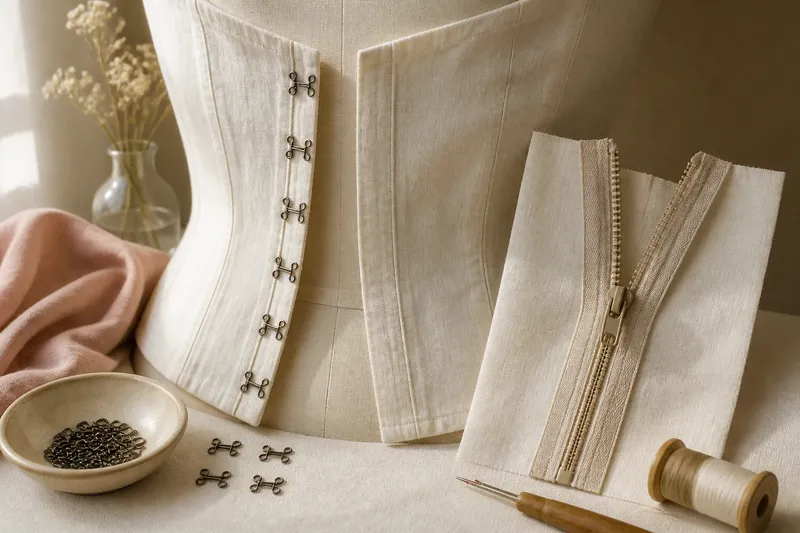
Before the zipper, hooks and eyes were one way to close clothing, fastening opposite edges at separate points. That arrangement helps explain what changed when the zipper appeared: a series of small catches became a closure operated along a track.
How did hooks and eyes hold clothing closed?
A hook and eye is a two-part fastening: a curved hook on one edge catches a loop on the other. Garment makers sew the parts opposite one another, placing them where the opening needs support. Each pair holds one point; the fabric between pairs remains unfastened.
To close a row, the wearer aligns each hook with its eye and catches them one at a time. To open it, each pair must be released. Placement can be tailored to a garment’s edge, which is useful for a discreet or local closure, but every fastening still needs to meet its counterpart.
Hooks and eyes were not the only pre-zipper option. Buttons, lacing and ties also closed garments, each suited to different designs. The hook and eye is a particularly clear example of a closure made up of distinct catches.
What did the zipper change?
A zipper uses two rows of interlocking teeth or other elements and a slider. Moving the slider joins or separates the rows along the opening. Instead of aligning several pairs individually, the wearer operates one mechanism that travels from one end to the other.
That mechanism changed how a garment opening could be closed, but it did not make every other fastening obsolete. A zipper creates a linked closure along a track; hooks and eyes still secure selected points. Garment design, fabric and the opening’s shape all affect which arrangement makes sense.
The difference is practical as well as visible. Separate catches can be placed individually, while a zipper needs room for its tape and a suitable path for the slider. A maker choosing between them is deciding how the opening should work, not simply which fastener is newer.
Which fastening suits which opening?
For a short, discreet closure, hooks and eyes may be enough. A zipper may suit an opening that runs farther along a garment and needs to close in one continuous operation. Neither choice is automatically more comfortable or durable: construction and use matter.
- Opening length: If the opening is short and needs only a few support points, consider hooks and eyes; if it runs along a longer section, consider whether a zipper track suits its shape.
- Reach: If the wearer can readily align each catch, separate fasteners may be manageable; if repeated alignment is awkward, consider a slider instead.
- Appearance: If the closure should be discreet at selected points, hooks and eyes may fit; if a continuous closure is acceptable, a zipper may fit better.
- Garment construction: If the fabric and cut can support a zipper tape without distorting the opening, that option remains possible; if they cannot, retain or choose a fastening that fits the edge.
- Finishing: If the top of a zipper needs to lie neatly against the garment, a hook and eye may secure that local point; if no separate catch is needed, the zipper may do the job alone.
- Repair: If the replacement part matches the existing construction and placement, it may be suitable; if it does not sit properly, consult a garment repairer before altering the opening.
Imagine a maker working on a fitted bodice with a back opening and a row of hooks and eyes. The maker considers replacing them with a zipper, checks whether the opening can accommodate zipper tape, and finds that the seam allowance is too narrow for the proposed track. The resulting decision is to keep the separate catches rather than force in a zipper; the observable result is an opening that continues to fasten at individual points, without added tape pulling the seam out of shape.
What do people ask about hooks and eyes before zippers?
Were hooks and eyes the only fasteners before zippers?
No. Buttons, lacing and ties were also used, depending on the garment and opening. Hooks and eyes are one useful example, not a complete history of clothing fasteners.
How can you tell a hook-and-eye closure from a zipper?
A hook-and-eye closure has distinct catches placed at intervals. A zipper has a slider that joins interlocking rows along a track.
Did the zipper replace hooks and eyes?
No. They can serve different purposes, and a garment may use both. A zipper can close a longer opening while a hook and eye secures a single edge or finishing point.
Why did hooks and eyes remain useful?
They can secure a small area without adding a long track. Their separate placement is useful where a garment needs an individual catch rather than a continuous closure.
Why are hooks and eyes still found alongside zippers?
The two fastenings solve related but distinct problems. A zipper operates along a track; a hook and eye secures a chosen point. A garment may use a zipper for its main opening and a hook and eye at the top to keep the edge aligned.
That division of labour is the lasting distinction behind the history of hooks and eyes before the zipper. The zipper changed the mechanism available to makers, while the smaller fastening remained useful wherever one secure point was enough. Look at how an opening operates, and the reason for using one, the other or both is often visible.